
Pan Am Airlines: The Story of the Airline That Made the World Feel Smaller
Explore the story of Pan Am Airlines, from flying boats to the jet age, and discover a new book about Pan American World Airways and its lasting legacy.

Some companies fade quietly. Pan Am never did. Decades after its last flight, the name still means something. Say "Pan American Airways" and people picture blue-and-white jets, sharp uniforms, and far-off cities that once felt impossibly glamorous to reach.
I wrote a book about all of it, and I'm thrilled to share the story with you here!
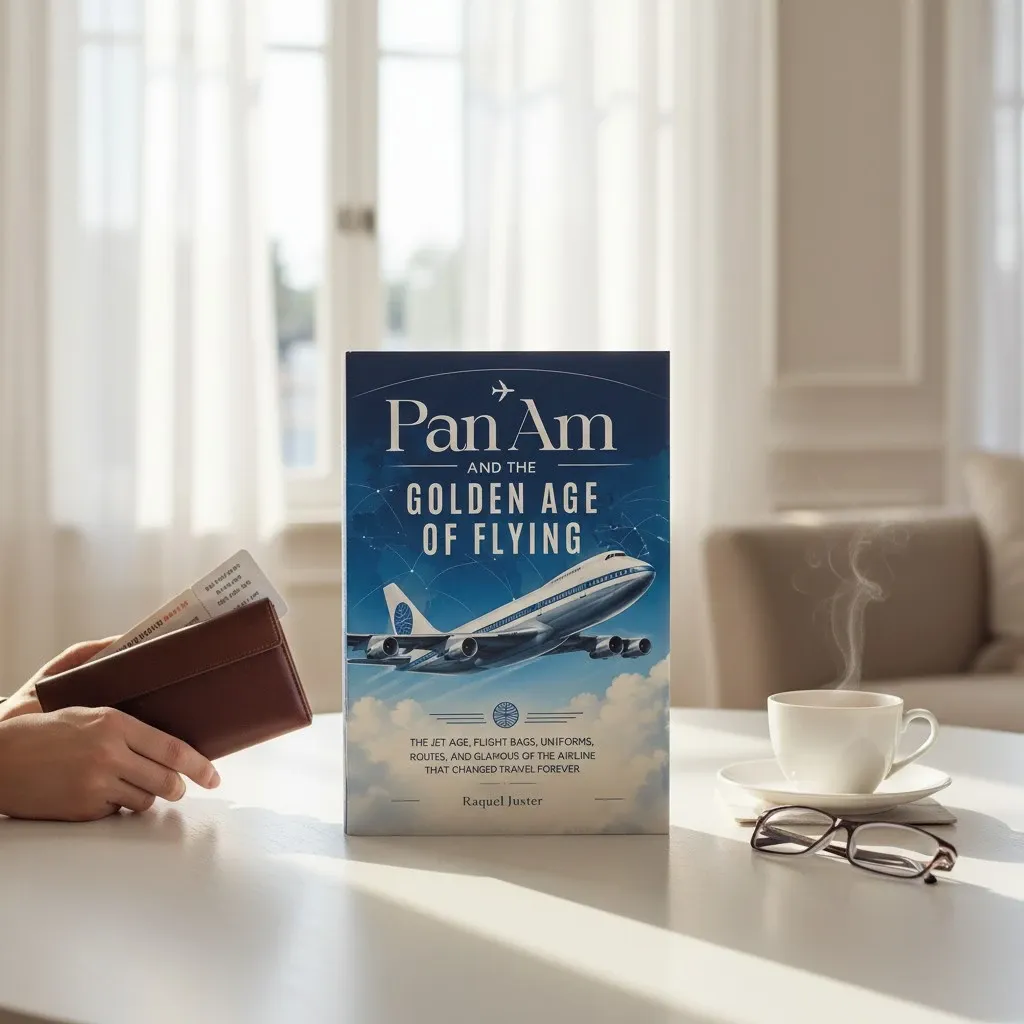
A warm, fact-based look at the airline that defined the golden age of flight — its aircraft, routes, style, and the reasons people still love it today.
Why Pan Am Still Matters
Pan American World Airways was more than a carrier. For much of the 20th century, it was how America reached the world. It flew the first passengers across oceans, opened routes to cities most travelers had only read about, and turned air travel into an event worth dressing up for.
At its peak, Pan Am was the largest international air carrier in the United States, serving routes to 86 countries and carrying roughly 11 million passengers annually. It held a near-monopoly on international routes that no other American airline could touch. It wasn't just an airline — it was a symbol of American ambition, technical confidence, and the idea that the world was getting smaller every year.
This is a deep dive into that story. If you love aviation history, international travel, or just the feeling that flying used to mean something more than it does today, I think you'll enjoy it as much as I loved researching and writing it!
A Short History of Pan Am
Pan American Airways was originally founded in 1927 as a small mail and passenger service operating between Key West, Florida, and Havana, Cuba. It was a modest start for an airline that would eventually connect the world.
Under founder Juan Trippe — one of the most driven and visionary figures in the history of the airline industry — Pan Am pushed outward fast. First across the Caribbean and Latin America, then south to Buenos Aires, and eventually across both the Pacific and the Atlantic. Trippe was relentless. He negotiated landing rights in countries that had never seen a commercial aircraft, built infrastructure in places where none existed, and insisted on routes others called impossible.
That early Pan Am history reads like an adventure novel. The airline hired the best navigators it could find, built airports in remote locations at its own expense, pioneered long-range weather forecasting specifically for oceanic crossings, and charted international air routes over stretches of open ocean that no one had flown on a regular schedule before. Pan Am didn't just use the airline industry — it helped create it.
Pan Am and Juan Trippe
Trippe deserves a section of his own. He ran Pan Am as something close to a personal mission, often working around competitors and regulators alike to extend the airline's reach. He had a gift for forming relationships with foreign governments, winning the contracts and landing rights that kept Pan Am ahead.
He also understood the value of aircraft early. Trippe was willing to commit to new planes before they existed on paper, which gave manufacturers the confidence to build them and gave Pan Am first-mover advantages that took years for other airlines to close.
Without Trippe, there is no Pan Am story worth telling. With him, the airline became something genuinely historic.
The Flying Boat Years
Before long paved runways spread across the globe, Pan American Airways used flying boats based out of Port Washington, New York. These weren't cramped, uncomfortable aircraft. They were large, elegant machines that carried passengers in real comfort — multi-cabin layouts, proper meals, and sleeping berths on the longer routes. The service was often described as luxurious and exclusive, setting a standard that Pan Am would carry forward into the jet age.
The Yankee Clipper, one of the most celebrated aircraft in early aviation history, made Pan Am's first transatlantic passenger service flight in June 1939, connecting New York to France and opening a new era of international air travel. It was a genuine milestone, and Pan Am made the most of it.
Across the Pacific, the flying boats crossed in a series of island hops, departing from San Francisco and moving through Hawaii, Midway, Wake Island, Guam, and on toward the Philippines and Asia. Pan Am introduced the first scheduled transpacific service in 1935 — a voyage that once took weeks by sea now took days by air. The flying boat era didn't last long, but it built Pan Am's reputation for going farther than anyone else.
The Clipper name stuck long after the flying boats retired. For decades, Pan Am continued calling its aircraft Clippers, borrowing the romance of the great sailing ships that had once ruled the seas.
Pan Am and World War II
When the United States entered World War II, Pan Am's global reach made it an immediate asset. The airline's routes, aircraft, local knowledge, and trained crews were put to work supporting the war effort. Pan Am flew supplies, personnel, and equipment across oceans that commercial aviation had only recently mapped.
The wartime experience expanded Pan Am's knowledge of long-range flying and pushed its operational capabilities further than peacetime competition ever had. When the war ended, the airline emerged with more experience, more infrastructure, and more confidence than almost any competitor. The boom years that followed were, in many ways, built on what Pan Am learned during the war.
Building the Pan Am Route Network
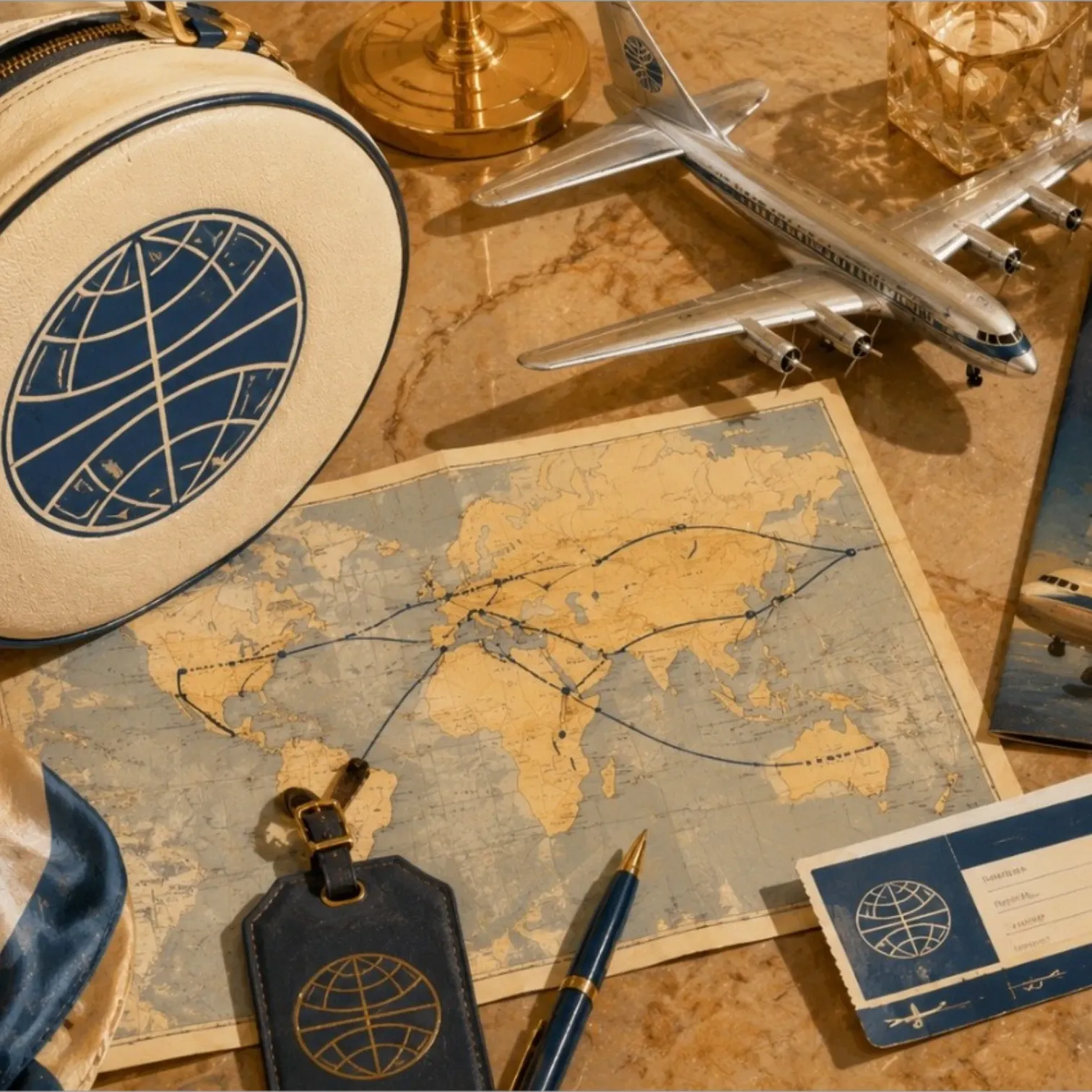
Pan American Airways built a network that felt truly global long before that was a common thing to say about an airline. At its height, Pan Am connected the United States to Europe, Asia, Africa, South America, and the South Pacific on a scale that no other American airline came close to matching. Serving routes to 86 countries, it was the kind of reach that made the name synonymous with international travel itself.
Some of the standout routes in Pan Am's history included:
- Transpacific service, linking San Francisco to Hawaii, the Philippines, Japan, and beyond — inaugurated in 1935 as the first scheduled transpacific service by any airline
- Pan Am's transatlantic routes, connecting New York to major European capitals including France, the United Kingdom, Germany, and Scandinavia
- Latin American routes, stretching from the Caribbean all the way to Buenos Aires and across the continent
- African and Middle Eastern service, reaching cities that most Americans had never considered flying to
- Round-the-world service, launched in 1947 as the first scheduled round-the-world service offered by any airline, letting passengers fly worldwide under a single carrier
For many people, Pan Am was international travel. If you were flying somewhere distant and important, chances were good you were flying Pan Am. World leaders, diplomats, and heads of state flew its routes. The airline carried presidents and shaped the way the world moved at the highest levels.
Competing With National Airlines and American Overseas Airlines
Pan Am didn't operate in total isolation, of course. In the postwar years, competitors began moving into international routes. National Airlines formed cooperative arrangements that let it access some transatlantic travel. American Overseas Airlines — a division that would eventually be absorbed into American Airlines — competed on some of the same transatlantic routes that Pan Am had pioneered.
Pan Am held its own, partly because of its head start and partly because of the sheer scale of its network. But the competitive pressure was real, and it would only grow over the following decades as other American carriers — including TWA, Braniff, and United Airlines — pushed harder into international markets.
The Chosen Instrument
For much of its history, Pan Am operated as what aviation policy specialists called the United States' "chosen instrument" — the unofficial flag carrier that represented American interests abroad. This wasn't a formal designation, but it functioned like one. The U.S. government often supported Pan Am's efforts to secure international routes, and Pan Am in turn helped advance American aviation and diplomatic interests around the world.
That role gave Pan Am advantages. It also created dependencies. When U.S. policy shifted and competition increased, Pan Am found itself without the domestic network that its rivals had built up over years of serving American cities.
The Pan Am Planes That Changed Flying
The story of Pan Am's aircraft is really the story of modern aviation. The airline had a habit of acting as launch customer for ambitious new planes, backing bold innovation before the technology was fully proven and then using the results to reshape the airline industry.
Flying Boats and the Douglas DC Series
Before the jet age arrived, Pan American Airways operated flying boats alongside the early landplane generation. The Douglas DC series gave Pan Am a capable fleet for its growing routes, offering longer range and better reliability than earlier aircraft. Each new type brought improved passenger service — more seats, smoother rides, and routes that extended a little further than before.
Pan Am introduced the Douglas DC-7C in the summer of 1956, giving the airline a propeller-driven aircraft capable of nonstop transatlantic crossings — a meaningful step forward in the years just before the jets arrived. Pan Am used this period to develop feeder flights, strengthen its domestic network, and prepare for the era of truly mass international air travel that was just beginning to take shape.
The Jet Age Arrives: Boeing 707
The moment that changed everything came in October 1958, when Pan Am helped launch scheduled Boeing 707 jet service as an American airline. The jet age had arrived, and air travel was never the same.
The 707 cut transatlantic crossing times dramatically. Routes that had taken the better part of a day on propeller-driven aircraft now took hours. Passengers arrived fresher. Airlines could fly more often. The economics of international travel shifted in ways that opened flying to far more people than before. Over roughly 20 years of service, Pan Am operated 120 Boeing 707-320 aircraft — a fleet size that underscores just how central the type was to the airline's identity and operations during that era.
Pan Am was the launch customer that made the 707 happen at commercial scale. Boeing needed that commitment to proceed with full production. Pan Am's willingness to order first gave the program the financial foundation it needed, and Pan Am got aircraft that left its competitors scrambling to catch up.
The Boeing 747: The Jumbo Jet
Then came something even bigger — literally. Pan Am worked closely with Boeing throughout the 1960s to bring the 747 into service, and on January 22, 1970, the first commercial Pan Am flight carrying passengers departed aboard the Jumbo Jet.
The 747 was enormous by the standards of the time. It carried far more passengers than anything flying before it, with a spacious cabin, a distinctive upper deck, and enough range to fly nonstop across oceans with room to spare. The aircraft made mass international travel genuinely affordable, spreading air travel to people who could never have imagined an overseas trip a generation earlier.
Pan Am was the first airline to fly the 747, and the plane became one of the most recognizable aircraft ever built. The image of a white-and-blue 747 wearing the Pan Am globe on its tail became one of the defining visual icons of the entire jet age.
The Ability to Fly Nonstop
One of the capabilities that kept Pan Am at the center of the airline industry for so long was its ability to fly nonstop across oceans. Where other airlines required stops or connections, Pan Am's range and equipment let it offer direct service that competitors couldn't always match.
Nonstop transatlantic and transpacific service wasn't just a convenience — it was a genuine competitive advantage, and Pan Am used it to hold its position as the dominant carrier on international routes even as the domestic market changed around it.
The Blue Globe: One of the Best Logos in Aviation History
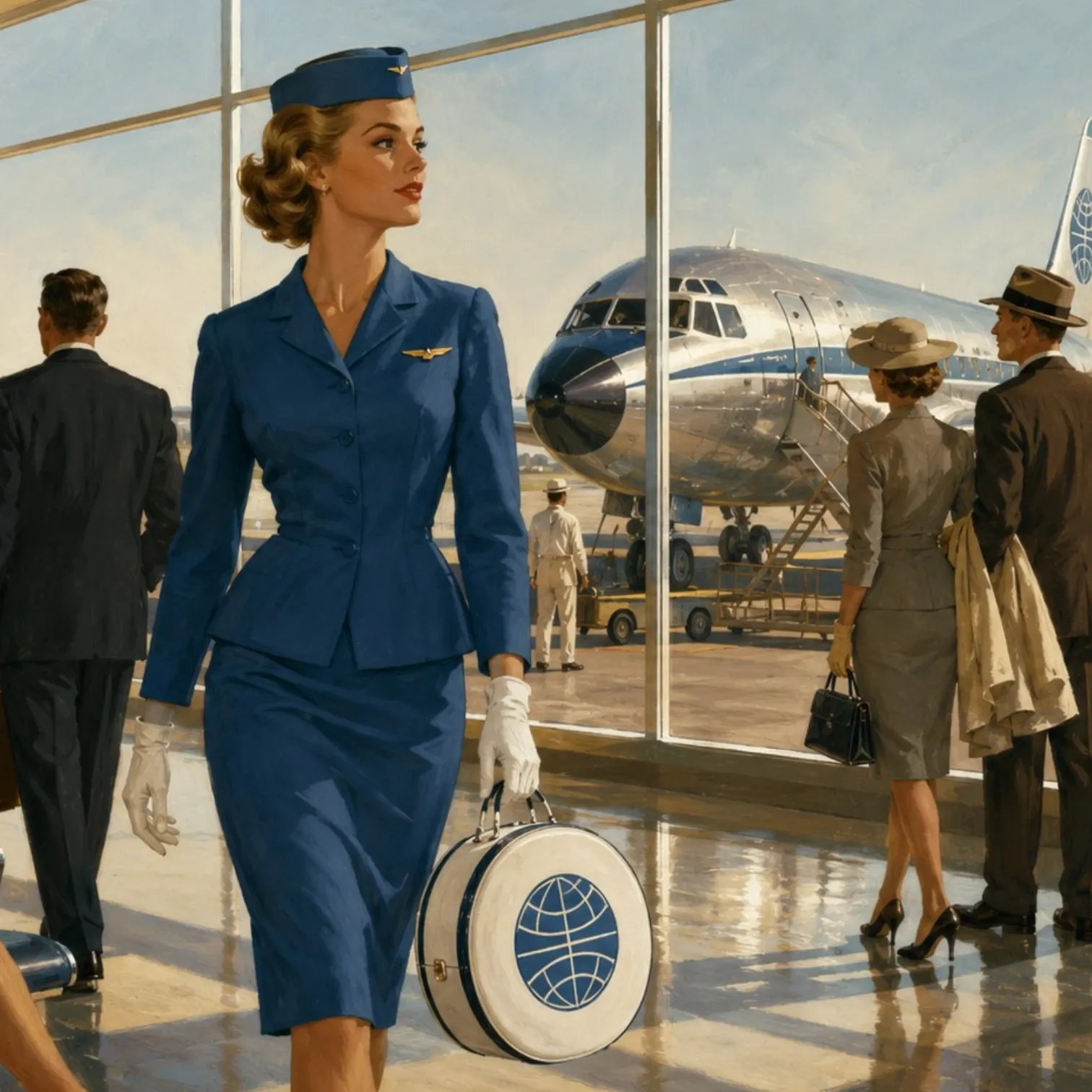
Let's talk about that logo! The Pan Am blue globe is simple, clean, and instantly recognizable. It appeared on tails, tickets, bags, and signs across the globe for decades.
Part of its genius was restraint. A globe made perfect sense for an airline that flew everywhere. The cool blue felt calm, trustworthy, and modern. The clean lines haven't dated the way busier logo designs from the same era have, which is why designers and collectors still admire it today.
The brand felt truly global because everything matched. The aircraft livery, the crew uniforms, the printed materials, the terminal signage, and the ticket jackets all looked like they belonged to the same carefully considered world. That kind of consistency takes real discipline, and Pan Am maintained it across decades.
The phrase "Pan Am smile" even entered the vocabulary of psychology — used to describe a polite, practiced service expression rather than a genuine one. The fact that a brand inspired its own psychological term shows just how deeply Pan Am had worked its way into everyday culture.
The Golden Age of Pan Am Service
Flying Pan Am in its prime was an experience, not just a transaction. The service was widely described as luxurious and exclusive — a standard that set the airline apart from almost any competitor on long-haul routes and gave it a reputation that advertising alone could never have built.
Cabin crews were trained to a high standard and held to it. Uniforms were sharp and consistent. Meals were served thoughtfully and reflected the destination or the route. Advertising leaned into glamorous destinations and the aspiration of becoming the kind of person who flew somewhere far away.
Destination posters showed sun-drenched cities, exotic coastlines, and ancient landmarks rendered in vivid color. The images said: this is within reach, and we will take you there. It was a powerful message at a time when international travel still felt like something beyond the reach of ordinary people.
What Pan Am Sold Beyond Seats
The airline understood something important: people weren't just buying a flight. They were buying an identity. Flying Pan Am meant you were someone who moved through the world with confidence. The brand reinforced that at every touchpoint — from the moment you bought your ticket to the moment you stepped off the plane.
That emotional intelligence helped Pan Am build loyalty that went far beyond price or schedule. Passengers didn't just prefer Pan Am. Many of them genuinely loved it.
The Worldport: Pan Am's Terminal at JFK
No discussion of Pan Am's golden age is complete without mentioning the Worldport. Built at what is now JFK Airport in New York, the Worldport opened in 1960 and quickly became a recognizable landmark — one of the most distinctive airport terminals in the world.
The design was bold and forward-looking — a sweeping circular roof that extended outward to shelter aircraft docking directly at the terminal. It was built to move passengers and planes efficiently at a scale that matched Pan Am's ambitions. The structure became a landmark in its own right, appearing in photographs, films, and news coverage for decades. For many travelers, walking under that canopy meant you were truly on your way somewhere important.
Pan Am and Long-Range Weather Forecasting
One aspect of Pan Am's history that doesn't get enough attention is the airline's contribution to aviation science. Flying over open ocean in the 1930s and 1940s was genuinely dangerous without accurate weather information. Pan Am invested in long-range weather forecasting specifically to make its transoceanic routes safer and more reliable.
The airline built weather monitoring infrastructure, trained its crews to read and respond to oceanic conditions, and developed operating procedures that made open-water flying manageable. Much of what we take for granted in modern transoceanic aviation has roots in what Pan Am and its competitors worked out during those early years.
Pan Am During the Jet Age Boom
The 1950s and 1960s were the peak years for Pan Am. The jet age made international travel faster and cheaper, and Pan Am was at the center of it all. New routes opened, passenger numbers grew toward that peak of roughly 11 million annually, and the airline's reputation reached its highest point.
This was also the era when Pan Am became a cultural fixture. It wasn't just an airline anymore. It was a reference point, a symbol, and a shorthand for the kind of international life that was becoming more accessible to more Americans every year.
The airline's competitors — including TWA, Braniff, American Airlines, and United Airlines — were all building their own international capabilities during this period, and the competitive picture was shifting. But Pan Am still held its position as the most recognizable American airline in the world.
The First Moon Flights Club
Here's one of my favorite stories from researching the book! In 1964, a journalist in Vienna walked into a travel agency and asked to book a flight to the Moon. The eccentric request found its way to Pan Am, whose executives took the reservation seriously and spun the idea into a marketing opportunity.
In 1968, the airline launched its "First Moon Flights" Club, inviting customers to book spots on a future lunar service. Projected start date: the year 2000. Members received a numbered card bearing their name on the front and a drawing of a Pan Am Space Clipper on the back.
Roughly 93,000 people signed up between 1968 and 1971, when the airline stopped taking reservations due to administrative and financial strain. The membership was cost-free, but the response was remarkable. Among those who signed up was broadcaster Walter Cronkite.
Pan Am maintained well into the 1980s that the program was genuine and that commercial space travel was coming. The airline never made good on that promise, but the companies now actually flying tourists to space — at prices starting around $125,000 per ticket — show that Pan Am's employees weren't entirely wrong about the direction of travel.
Few brands in any industry have ever earned the kind of trust that Pan Am built through that campaign. People were willing to book a seat on a Moon flight that didn't exist because they genuinely believed Pan American Airways could pull it off.
Pan Am in Pop Culture
Filmmakers and storytellers understood Pan Am's power early on. A Pan Am jet appearing in a scene did quick work — signaling sophistication, international movement, and a certain kind of worldly confidence without a single line of dialogue. The airline was featured in several James Bond films and became easy visual shorthand for the jet-set life.
2001: A Space Odyssey
In Stanley Kubrick's 2001: A Space Odyssey (1968), a sleek spaceplane often called the "Pan Am Space Clipper" carries a passenger to an orbiting space station. Audiences accepted the image instantly. Pan Am already stood for long-distance travel, technical innovation, and the future. Putting its logo on a spacecraft felt completely logical.
The inclusion wasn't accidental. Kubrick and his team wanted the future to feel believable and grounded. Using a Pan Am flight as the delivery mechanism for a trip to space gave the scene an everyday quality that made the extraordinary feel almost routine.
James Bond
Pan Am was featured in several James Bond films and became closely associated with the world of international espionage and style the series depicted. In Live and Let Die (1973), a Pan Am jumbo jet is seen bringing 007 to New York, with the footage incorporated cleverly into a scene involving Tarot card imagery. Pan American Airways also produced a color promotional poster tied to the film, displayed in travel agencies to highlight the Caribbean locations featured in the movie.
The pairing made intuitive sense. Bond and Pan Am both represented crossing borders with style and confidence — images of a certain kind of worldly life that audiences recognized and admired.
Blade Runner
The brand appeared in imagined futures too. Ridley Scott's Blade Runner (1982) featured Pan Am advertising in its rain-soaked, neon-lit cityscape. A Pan Am sign turns up in the dystopian Los Angeles of 2019 as a familiar detail in an unfamiliar world. The 2017 sequel Blade Runner 2049 nodded to it again.
When a brand shows up in a vision of a distant future, you know it has become deeply embedded in the cultural imagination. Pan Am wasn't just associated with travel — it was associated with movement, modernity, and the texture of an interconnected world.
The 2011 ABC Pan Am TV Show
Pan American Airways stopped flying in December 1991. Yet its image kept traveling long after the last Clipper touched down.
In 2011, ABC launched a television series simply called Pan Am, following the lives of a 1960s flight crew through international routes and the personal adventures that came with that world. The show arrived two full decades after the airline's collapse, yet audiences grasped the setting immediately.
The visual language worked because Pan Am had built something genuinely enduring. Blue uniforms, bustling international terminals, exotic destinations, and the idea of flight crews living global lives across continents — none of it needed explanation. The brand still carried meaning without any supporting context.
The show's existence says something important about Pan Am's cultural afterlife. You don't make a prime-time television series about a bankrupt airline unless you believe audiences will connect with it. ABC believed. And they were right.
Rising Competition and the Decline of Pan Am
No story of Pan Am is complete without an honest look at why it ended.
The airline faced rising competition throughout the 1970s and 1980s as American carriers built their own international routes. TWA, Braniff, United Airlines, and American Airlines all pushed harder into markets that Pan Am had once dominated. Deregulation in 1978 changed the domestic aviation landscape and put pressure on carriers that had built their models around protected routes. Pan Am, which lacked the domestic network that rivals had developed over decades, found itself exposed.
The airline tried to fix the gap. It purchased National Airlines in 1980, acquiring a domestic network to feed its international routes. The acquisition was expensive and the integration was difficult. Rather than solving Pan Am's problems, the National Airlines purchase added debt and complexity at a moment when the airline could least afford either.
Fuel costs, economic downturns, and increasing competition from foreign carriers further squeezed margins. The Lockerbie bombing in December 1988 — when Pan Am Flight 103 was destroyed over Scotland — dealt a devastating blow to the airline's reputation and its transatlantic bookings. Pan Am never fully recovered.
The airline sold off assets piece by piece during its final years, including the Intercontinental Hotels chain and the profitable transatlantic routes that had been its core business for decades. On December 4, 1991, Pan American World Airways filed for bankruptcy and ceased operations.
It was an abrupt end for a company that had once seemed invincible.
What Pan Am Actually Built
It's worth stepping back from the decline and recognizing the scale of what Pan Am actually achieved.
The airline built airports in places that had none. It introduced the first scheduled transpacific service in 1935 and launched the first round-the-world scheduled service in 1947. It developed oceanic navigation techniques that the rest of the industry adopted. It created systems for transoceanic weather monitoring that improved safety across all long-range flying. It launched the 707 era and the 747 era, reshaping what international travel could be and who could afford it.
PANAMAC — Pan Am's early computerized reservation system — was one of the first of its kind in the airline industry and pointed toward the digital booking infrastructure that the entire industry would eventually build.
Pan Am trained crews to standards that influenced how other airlines thought about passenger service. It negotiated landing rights in dozens of countries, establishing the legal and diplomatic frameworks for international air travel that others later used. At the height of its network, it connected passengers to 86 countries and carried roughly 11 million people per year — numbers that reflect not just a successful airline but a genuine force in reshaping how the world moved.
The corporation failed. The achievements didn't.
The Pan Am Legacy Today
The Pan Am legacy lives on in ways that would probably surprise the airline's former executives. The logo and name keep reappearing on new products decades after the last flight.
Funko released a Pan Am board game that lets players build their own airline empire, buying stocks and claiming routes in a light strategy format designed for two to four players. The Pan Am Museum Foundation operates a shop selling apparel and accessories built around the airline's classic imagery — caps, polo shirts, t-shirts, luggage tags, and more — with proceeds supporting the preservation of Pan Am's history.
These aren't products for people who flew Pan Am. Many of the buyers were born after the airline closed. They're drawn to the image, the design, and what the name represents — a time when international travel felt like a significant event and the world was genuinely opening up.
That staying power comes from a simple but rare combination: strong design, clear emotional meaning, and a public memory of air travel as something special rather than something to endure. The planes are gone, the routes belong to other carriers, and the headquarters carries a different name. But the image Pan American World Airways built turned out to be more durable than the business behind it.
That's really what drove me to write the book. Pan Am gave the world a way to picture travel at its most hopeful and far-reaching. Decades later, that picture still resonates!
Frequently Asked Questions About Pan Am
When did Pan American Airways start and stop flying?
Pan American Airways was originally founded in 1927 as a mail and passenger service between Key West, Florida, and Havana, Cuba. It grew into the largest international air carrier in the United States before ceasing operations in December 1991.
Who founded Pan Am?
Pan Am was founded by Juan Trippe, one of the most influential figures in the history of commercial aviation. Trippe ran the airline for decades and was the driving force behind its global expansion.
What was the Yankee Clipper?
The Yankee Clipper was one of Pan Am's most celebrated flying boats. It completed the airline's first transatlantic passenger service flight in June 1939, linking New York to France and opening the era of scheduled commercial international air travel across the Atlantic.
What aircraft was Pan Am most famous for?
Pan Am is closely associated with two Boeing jets. It introduced the Douglas DC-7C in 1956 as a capable long-range propeller aircraft, then acted as launch customer for the 707 in 1958, helping launch scheduled jet service for an American airline. It was also the first airline to fly the Boeing 747 commercially in 1970. The Jumbo Jet in Pan Am colors became one of the defining images of the entire jet age.
What was the Pan Am blue globe logo?
The airline's simple blue-and-white globe symbol. Clean and modern in design, it appeared on aircraft, tickets, bags, and signage across the world. It remains one of the most admired logos in aviation history and continues to appear on apparel and collectibles today.
Was the First Moon Flights Club real?
It was a genuine marketing program. Pan Am launched it in 1968 after a journalist's request to book a lunar flight reached the airline and sparked the idea. Around 93,000 people signed up before the program stopped taking reservations in 1971. Pan Am maintained the program was serious into the 1980s, though the airline never flew anyone to the Moon.
Why did Pan Am fail?
Several factors combined to bring Pan Am down. The airline lacked a domestic network, which left it dependent on international routes that became increasingly competitive after deregulation. The costly acquisition of National Airlines in 1980 added debt without solving the underlying problem. Rising fuel costs, competition from TWA, Braniff, United Airlines, and foreign carriers, and the devastating impact of the Lockerbie bombing in 1988 further weakened the airline before it finally ceased operations in 1991.
Where did Pan Am fly?
Pan Am built a global network spanning routes to 86 countries at its peak, connecting the United States to Europe, Latin America, Asia, and Africa, with service reaching cities from Buenos Aires to San Francisco to Paris. It was particularly known for its transatlantic routes, its transpacific service — first introduced in 1935 — and its round-the-world service launched in 1947.
Is the 2011 Pan Am TV show based on the real airline?
Yes. The ABC series was a fictional drama set in the 1960s, built around the real airline's style, uniforms, international routes, and the world that flight crews of that era inhabited.
What is the Pan Am Museum?
The Pan Am Museum Foundation is dedicated to preserving the history, legacy, and story of Pan American World Airways. It maintains archives, supports research, and operates a shop where Pan Am-inspired merchandise helps fund the museum's preservation work.
Thanks so much for reading, and for sharing my passion for aviation history! If Pan Am sparks your curiosity the way it does mine, I'd be honored to have you explore the full story in the book. There's so much more in there — from the flying boat era to the final years, from the aircraft to the people who made it all work.
Happy travels! 🌍
Raquel