
Old Las Vegas Hotels: A Love Letter to Neon, the Rat Pack, and the Strip We Lost
Explore the timeless allure of old Las Vegas hotels, where nostalgia meets charm. Join us on a journey through history and experience their unique stories.

Picture this. You are driving through the pitch-black Mojave Desert in a vintage convertible sometime around 1960. The warm night air rushes past the windshield. Then, out of nowhere, a glowing oasis of neon bursts against the horizon. Pink flamingos. Cursive script twenty feet tall. A giant fiberglass sultan watching over the highway. The black sky catches fire.
That was old Las Vegas. And most of it is gone now.
I wrote a whole book about it, and I could not be more excited to share the story with you here. If you love Las Vegas history, vintage Americana, or you just wish you could walk beneath those old signs one more time, this one is for you. By the end of this post, you will know exactly which classic resort hotels shaped the city, why they disappeared, and where you can still find pieces of them today.
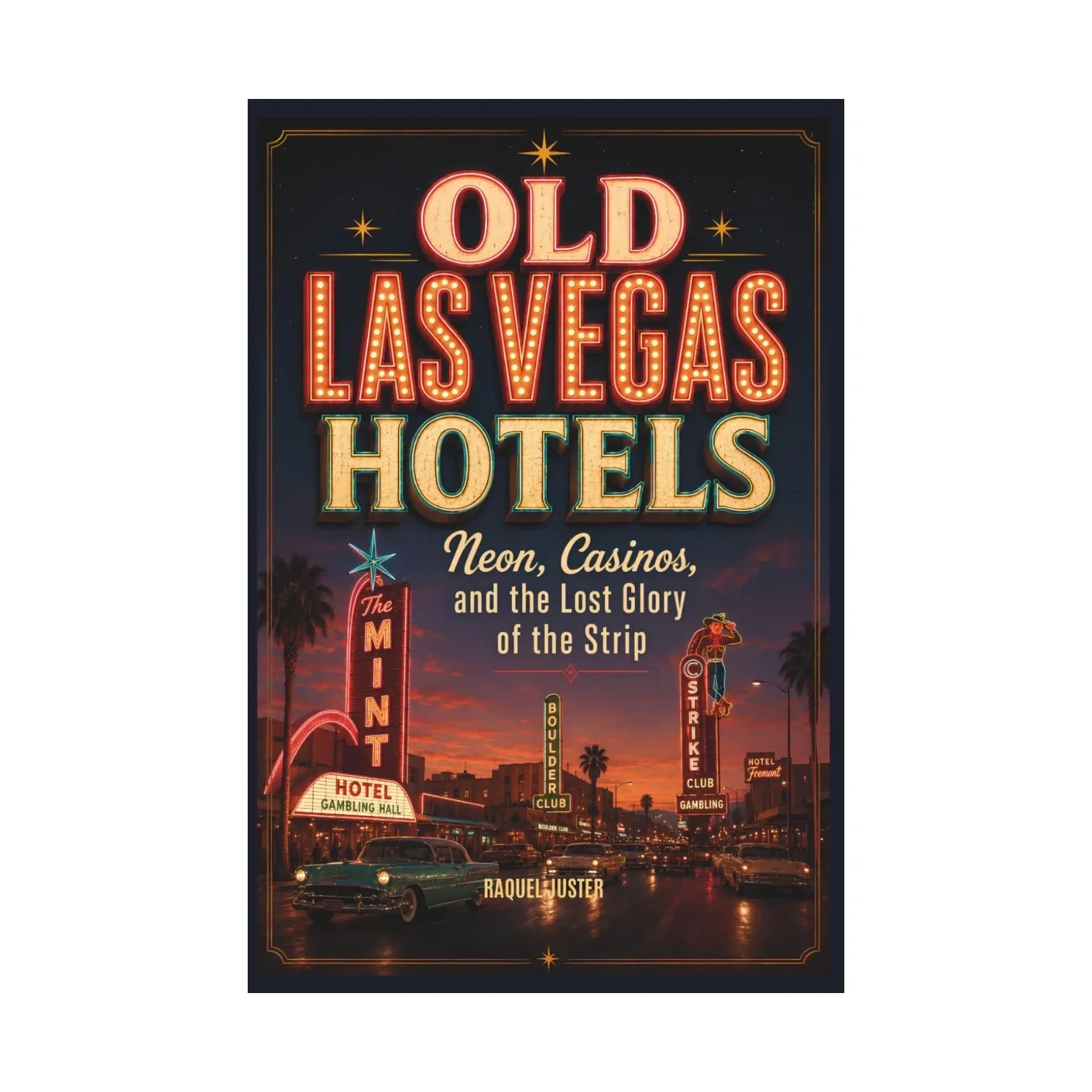
A warm, nostalgic tour through the classic hotels that turned a dusty stretch of Las Vegas Boulevard into the most famous road in the world.
What Were Old Las Vegas Hotels?
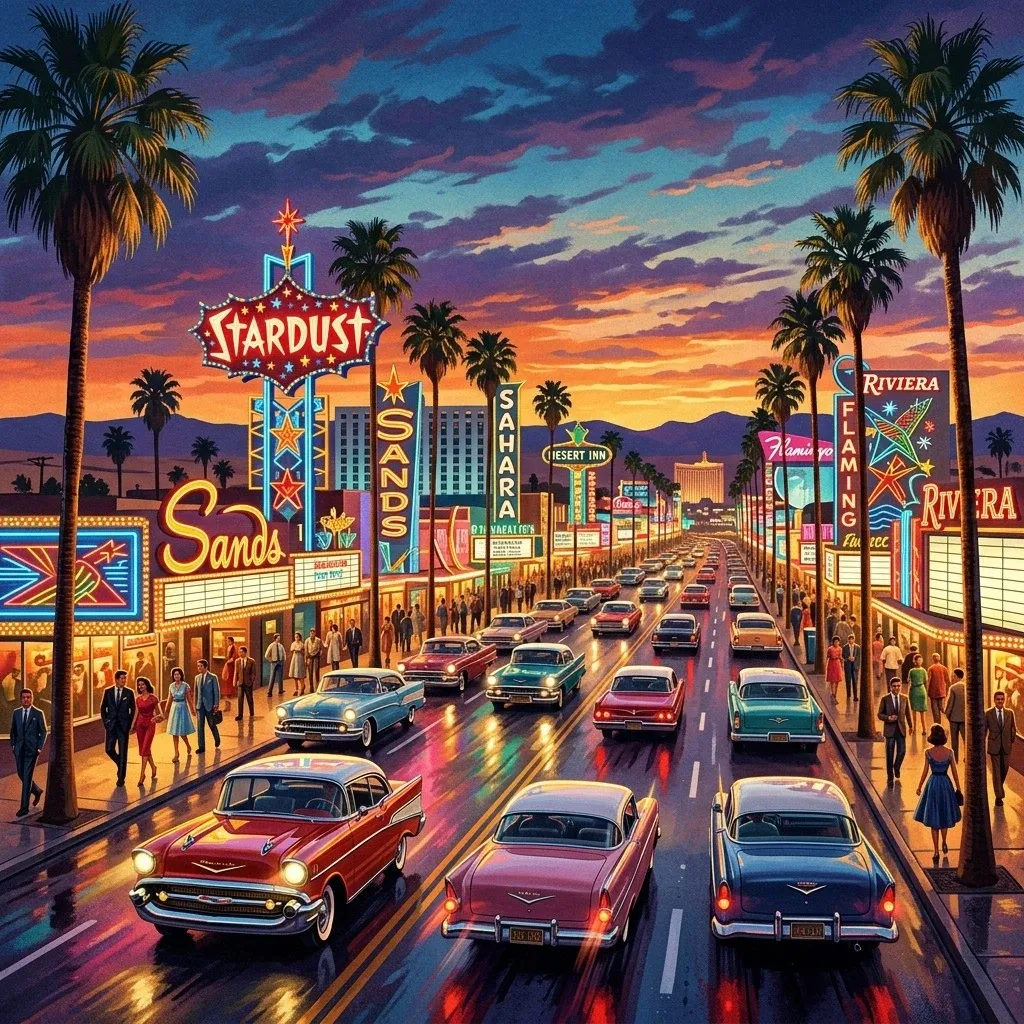
Old Las Vegas hotels were the classic resort hotels and casinos that lined the Las Vegas Strip and downtown Fremont Street from the 1940s through the 1980s, long before the mega-resort era took over. These were the properties that gave old Vegas its unforgettable personality — intimate, themed, celebrity-driven, and electric with neon from curb to rooftop.
The Las Vegas Strip is a roughly 4-mile stretch of Las Vegas Boulevard that became the beating heart of mid-century American leisure. The most famous old Las Vegas hotels along that stretch include the Flamingo, the Sands, the Desert Inn, the Stardust, the Tropicana, the Riviera, the Dunes, the Sahara, the Hacienda, the Aladdin Hotel, El Rancho Vegas, the Last Frontier, and the New Frontier. Together, these resort hotels defined Las Vegas history and turned a dusty two-lane highway into one of the most recognizable stretches of real estate on earth.
Most of them are gone now. What replaced them is a different city entirely.
Why I Wrote This Book
Las Vegas is a city that eats its own history. It tears down its past with dynamite and national television broadcasts, then paves right over the rubble with a fresh parking lot. The intimate, personality-driven resort city of the mid-20th century has been almost entirely buried under today's corporate mega-resorts.
And honestly? That stings a little.
It stings to walk down the Las Vegas Strip and look up at a massive glass box standing exactly where Frank Sinatra used to toss down a Jack Daniel's, or where a fifty-foot neon sultan once glowed over the traffic. So much of old Vegas now lives only in memory, in old photographs, and in the archives of places like the Neon Museum.
This book is my way of keeping that glow alive. It is not a dry textbook. It is a guided, immersive walk down memory lane through a world that no longer exists physically but still burns bright in the American imagination.
A Quick Tour of Las Vegas History
Before the billion-dollar towers, Sin City was a small desert town where the money was downtown, not on the highway.
Downtown had its own legends. The Golden Gate Hotel & Casino — originally opened in 1906 as Hotel Nevada — is the oldest hotel in Las Vegas and one of the anchors of Fremont Street, the beating heart of early gambling. In 1941, the El Cortez Hotel opened as the first resort-style hotel in the downtown area, setting an early template for what Las Vegas hospitality could look like.
The Strip story starts that same year, when a California hotelier blew a tire on a dusty road and realized he could build an oasis right where the road-trippers were passing by. That was El Rancho Vegas, widely remembered as the first hotel on what would become the Las Vegas Strip. Just down the road came the Last Frontier, leaning hard into a cowboy fantasy with wagon wheels and stagecoaches. These early resort hotels set the template: build outside the city limits, trap the tourists with a pool and cheap food, and let the casino do the rest.
In the book, I trace how the center of gravity slowly shifted from Fremont Street out to Las Vegas Boulevard, one glowing sign at a time.
Old Vegas vs. the Modern Las Vegas Strip
One thing that surprises a lot of people is how different the old resort hotels felt compared to what lines the Strip today — and how many of those differences still matter if you visit Las Vegas now.
The classic hotels were intimate and personality-driven. The rooms were smaller, the ceilings were lower, and the casino floors were designed to feel like they belonged to someone rather than to a corporation. Today, the mega-resorts are architectural spectacles — enormous, technically flawless, and very expensive.
A few things that are still true about old Vegas compared to the modern Strip:
- Cost: Staying in older parts of Las Vegas — particularly downtown near Fremont Street — is generally less expensive than staying on the Strip. Room rates, food prices, and drink minimums tend to run lower.
- Odds: Old Vegas and downtown casinos often offer better odds and lower table minimums than the big Strip resorts. If you actually want to gamble without burning through money, the off-Strip casinos are worth knowing.
- Shows: The modern Strip hosts massive productions like Cirque du Soleil and arena-scale residencies that simply did not exist in the classic era. The showrooms of old Vegas were intimate — 500 seats, two drinks minimum, and the Rat Pack twelve feet away.
- Atmosphere at night: The honest truth is that some parts of old Vegas and downtown can feel a little rougher at night compared to the heavily secured mega-resort corridor. That edge was part of the charm once. Today it is just part of the reality.
None of this is a knock on old Vegas. It is just context. The classic era had something the modern Strip cannot buy — a specific, irreproducible electricity.
The Old Las Vegas Hotels That Built the Legend
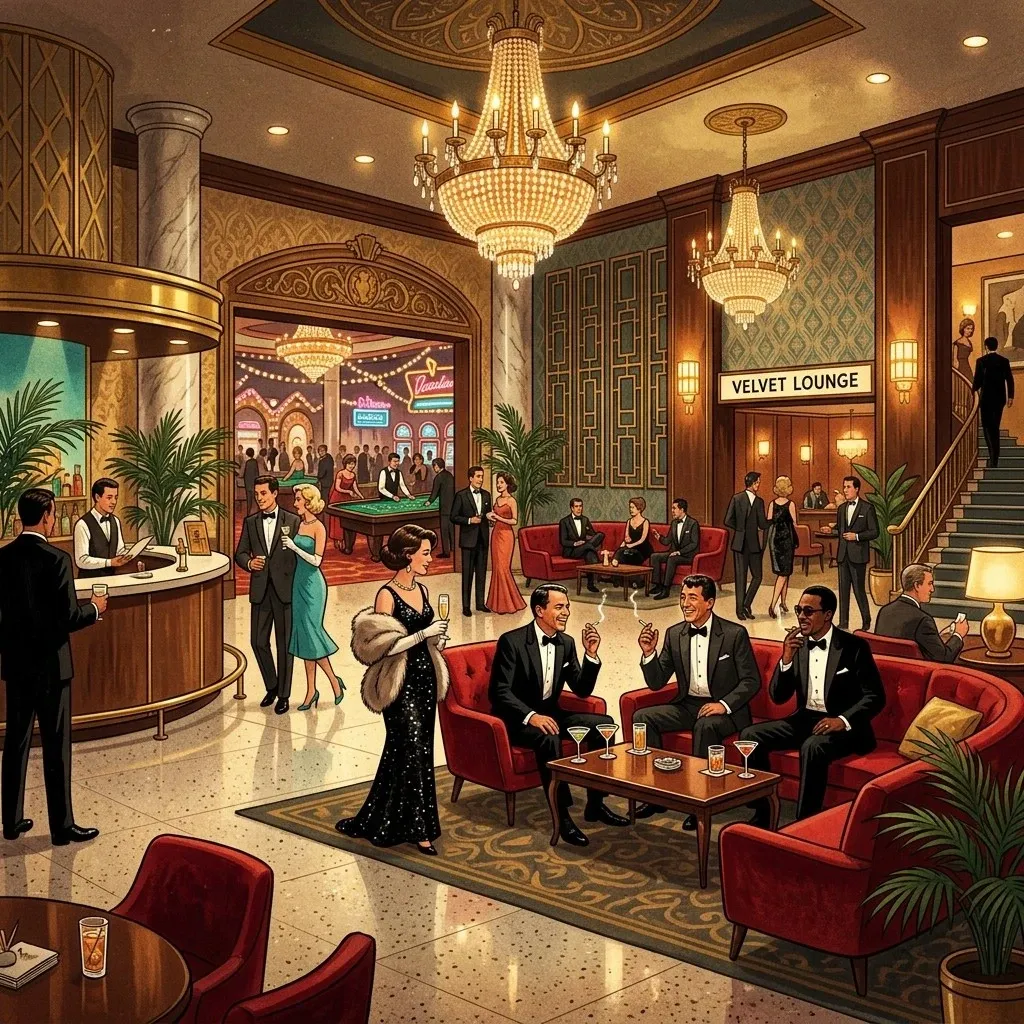
Each classic resort had its own personality, its own story, and its own role in turning a strip of desert highway into a legend. Here is a look at the properties covered in the book.
The Flamingo, Bugsy Siegel, and the Mob Money
The Flamingo opened in December 1946 with a style of modern architecture that was unlike anything else on Highway 91 at the time. Where El Rancho and the Last Frontier sold cowboy charm, the Flamingo offered a tropical Miami fantasy in the middle of the desert — palm trees, thick carpet, no clocks, no windows. It was designed to disorient you just enough to keep you gambling.
You cannot tell the story of Las Vegas history without the mob. Bugsy Siegel is where the popular myth enters, though the real story is messier and more interesting. The mob involvement behind the scenes financed much of early Vegas through hidden cash and straw-man owners, and I dig into how that shadowy money actually worked.
The Sands, the Rat Pack, Frank Sinatra, and Sammy Davis Jr.
If old Vegas had a beating heart of pure cool, it lived inside the Copa Room at the Sands. This was the home turf of the Rat Pack. Frank Sinatra, Dean Martin, and Sammy Davis Jr. turned that little showroom into the center of the American universe, and the famous Sands marquee promised, "Maybe you'll see them all."
The Sands is also where Sammy Davis Jr. helped break down segregation on the Strip, and where a young Steve Wynn would later cross paths with the old guard. It is one of my favorite chapters in the book.
The Desert Inn and Howard Hughes
The Desert Inn sold quiet, country-club luxury, complete with a championship golf course in the middle of the desert. It is also where the reclusive billionaire Howard Hughes famously bought the entire hotel simply because he refused to leave his room. That single strange decision helped kick off the corporate era that would eventually replace old Vegas entirely.
The Sahara: A Moroccan Fantasy on the Strip
The Sahara Hotel opened in 1952 as a Moroccan-themed resort, bringing a completely new kind of escapism to Las Vegas Boulevard. Two sculpted camels stood guard at the entrance. Waitresses wore harem costumes. The showroom became ground zero for lounge culture when Louis Prima and Keely Smith took the Casbar Lounge stage and played until dawn every night.
The Tropicana: The Most Expensive Resort of Its Time
When the Tropicana Hotel opened in 1957, it was the most expensive resort ever built in the American West. Owner Ben Jaffe spent $15 million — an almost unimaginable sum for the era — to create a Cuban-inspired paradise complete with lush landscaping, mahogany walls, and eventually a million-dollar stained-glass ceiling over the casino floor. The Tropicana's long-running Folies Bergère show became the gold standard for Las Vegas showgirl entertainment.
The Dunes, the Riviera, and the Stardust
The Dunes gave us the Sultan of the Strip and one of the most famous farewells in Las Vegas history. The dunes implosion in 1993 was treated like a national holiday, with fireworks and a televised pirate-ship spectacle that drew 200,000 people to Las Vegas Boulevard.
The Riviera broke the skyline in 1955 as the first true high-rise on the Strip, where Liberace made history with a record-shattering $50,000-per-week paycheck. The Riviera Hotel closed in May 2015 after 60 years of operation — long outlasting almost every peer from its era.
The Stardust wore the greatest neon facade ever built while quietly running one of the largest skimming operations in Las Vegas history. The Stardust Resort was imploded on March 13, 2007, closing the book on the Strip's most galactic landmark.
The Aladdin Hotel, the Frontier, and the Landmark
The Aladdin Hotel is where Elvis and Priscilla said "I do." The New Frontier — originally the Last Frontier before its reinvention — gave a young, terrified Elvis his first Vegas flop in 1956, then later launched Siegfried & Roy into international fame. The Frontier Hotel closed in July 2007 after 65 years of operation, one of the last classic-era names to fall to the wrecking crews. The Tally-Ho, one of the Strip's most spectacular early failures, eventually became the Aladdin through Milton Prell's vision. And the Landmark, that space-age flying saucer, made its final appearance getting vaporized in the movie Mars Attacks!
What Replaced the Old Las Vegas Hotels?
Everything changed in 1989 when Steve Wynn opened the Mirage with an erupting volcano out front. That single move made every classic property look like a dinosaur overnight.
What followed was a complete transformation of the Las Vegas Strip. The mob-era resort hotels that once lined Las Vegas Boulevard were demolished one by one, replaced by a new generation of massive, corporate-owned mega-resorts. It is worth remembering that Caesars Palace, which opened in 1966, actually helped pioneer the themed mega-resort concept years before the Mirage arrived — its Roman architecture and columned facade showed what an entirely fabricated world inside a casino could look like.
The arms race of scale that Wynn triggered produced the MGM Grand, the Luxor pyramid, Mandalay Bay, and the empire that became Caesars Entertainment. Eventually, today's giants arrived — Wynn Las Vegas, the massive Resorts World, the Fontainebleau Las Vegas, and the New York-New York complex that brought a Manhattan skyline to the desert.
Here is how some of the most famous old Las Vegas hotels were replaced:
- Desert Inn → Wynn Las Vegas — imploded on October 23, 2001; Steve Wynn used the old golf course dirt to build an artificial mountain
- Dunes → Bellagio — the 1993 dunes implosion made room for Wynn's most famous project
- Stardust → Resorts World — imploded March 13, 2007; the site sat empty for years before Genting built what stands there today
- Sands → The Venetian — demolished November 26, 1996; Sheldon Adelson built his convention empire on the site
- Tropicana → demolished in 2024 for a Major League Baseball stadium
- Hacienda → Mandalay Bay — blown up live on national television on New Year's Eve 1996
- Aladdin Hotel → eventually became Planet Hollywood
- Riviera → closed May 2015; demolished for Las Vegas Convention Center expansion
- Frontier Hotel → closed July 2007; demolished for a development that stalled in the financial crisis
Operators like Boyd Gaming helped clean up and modernize what the mob left behind. Today, every New Year's Eve, huge crowds gather on Las Vegas Boulevard to celebrate a skyline that would be completely unrecognizable to Bugsy Siegel.
What You Will Love Inside the Book
If any of this makes your heart beat a little faster, this book was written for you.
The Neon and the Artists Who Made It
Before the digital screens, Las Vegas Boulevard glowed with miles of hand-bent glass tubing. I take you inside the world of the tube benders — the artists who wrestled fire and gas into the greatest gallery of commercial folk art the world has ever seen. You will learn how the Neon Museum rescued these signs from the scrap heap so you can still stand beneath them today.
The Showmen, the Rat Pack, and the Showgirls
You will sit in the showroom while the Rat Pack tears up the stage. You will meet the towering, impossibly disciplined showgirls who balanced fifty-pound headdresses while smiling like it was effortless. This was live entertainment and performing arts at their most electric, long before the arena era and long before Cirque du Soleil turned the modern Strip into a world of acrobatic spectacle.
The Lounge Culture Born at the Sahara
Some of the best nights in old Vegas happened at 3 a.m. in a tiny lounge. When Louis Prima and Keely Smith took the Casbar Lounge stage at the Sahara in 1954, they turned background music into a cultural explosion. That specific, sleep-deprived magic gets its own full chapter.
The Money, the Mob, and the Gaming License
The real story of old Vegas runs on hidden cash, straw-man owners, and the infamous "skim." I cover the mob involvement that built the Strip, the financial troubles that brought these places down one by one, and how a changing gaming license landscape eventually pushed the outlaws out and let Wall Street in.
The Reinventions and the Financial Struggles
These hotels survived by constantly changing their skins. The Tally-Ho became the Aladdin. The Last Frontier became the New Frontier. I love these stories because they show how ruthlessly this city reinvents itself, and how a single round of financial struggles could erase a legendary name overnight.
Where You Can Still Experience Old Vegas Today
The classic hotels are mostly gone, but old Vegas is not completely lost.
The Neon Museum in Las Vegas is the single best place to experience the old Strip. The outdoor Boneyard holds restored and unrestored signs from dozens of demolished hotels, including the Stardust, the Riviera, and the Sahara. Walking through at dusk — when the restored signs are switched back on — is one of the most emotional experiences Las Vegas has to offer.
Fremont Street in downtown Las Vegas still carries more of the old soul than the modern Strip does. The Golden Gate, which opened in 1906 as Hotel Nevada and holds the title of oldest hotel in Las Vegas, still operates there. The famous neon cowboy Vegas Vic still stands, and the street itself still has the compressed, electric energy that defined the earliest era of the city.
Las Vegas Boulevard itself tells the story through what is missing. The empty lots, the architectural contrasts, and the plaques scattered across the Strip mark the spots where history once stood.
And of course, the book itself is its own form of time travel — a guided tour through every hotel, every showroom, every lounge, and every implosion, told in detail that no walking tour could match.
Who This Book Is For
This one is for the people who feel a pull toward the neon. If you love Las Vegas history, road trip nostalgia, vintage Americana, or you just wish you could walk beneath those old signs one more time, you will feel right at home in these pages.
It is also a lovely gift for anyone who:
- Remembers staying in a classic Vegas hotel room back in the day
- Collects old Vegas memories, matchbooks, or casino chips
- Loves the Rat Pack, Frank Sinatra, and Dean Martin
- Grew up on classic movies filled with green felt and crystal chandeliers
- Wants a warm, easy read that feels like a walk down memory lane
Frequently Asked Questions About Old Las Vegas Hotels
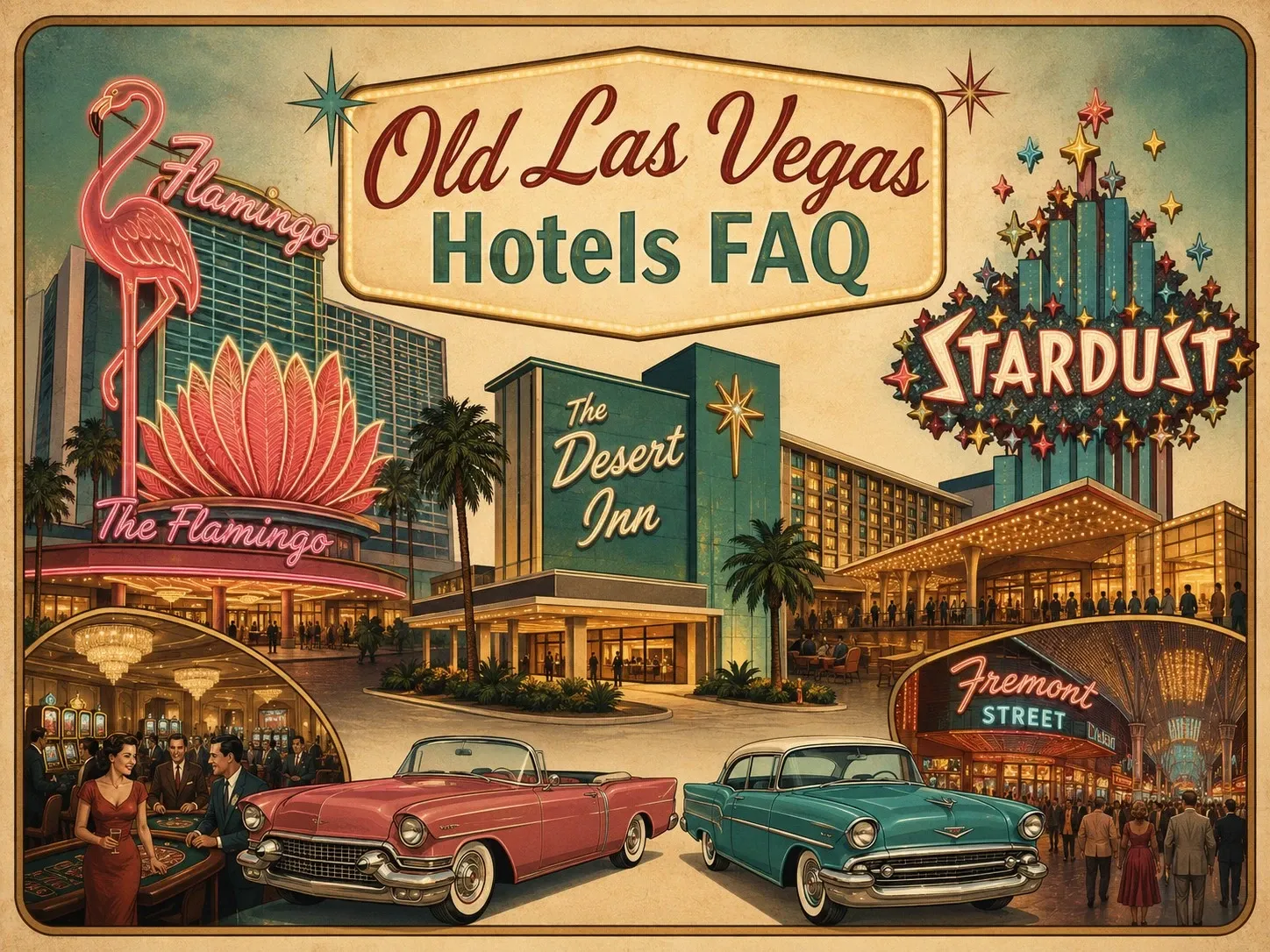
What were the most famous old Las Vegas hotels?
The most famous old Las Vegas hotels include the Flamingo, the Sands, the Desert Inn, the Stardust, the Dunes, the Tropicana, the Riviera, the Sahara, the Hacienda, the Aladdin Hotel, El Rancho Vegas, the Last Frontier, and the New Frontier. These classic resort hotels shaped the Las Vegas Strip from the 1940s through the 1980s before being replaced by modern mega-resorts.
What was the first hotel on the Las Vegas Strip?
El Rancho Vegas, which opened in 1941, is widely considered the first hotel on what became the Las Vegas Strip. It was followed shortly after by the Last Frontier, and together they established the resort hotel model that defined Las Vegas history for the next four decades. Downtown, the El Cortez Hotel also opened in 1941 as the first resort-style hotel in that part of the city.
What is the oldest hotel in Las Vegas?
The Golden Gate Hotel & Casino, which originally opened in 1906 as Hotel Nevada, is the oldest hotel in Las Vegas. It still operates on Fremont Street today and remains one of the most historically significant properties in the city.
When did the major old Las Vegas hotels close or get demolished?
Most of the classic Las Vegas hotels were demolished from the 1990s onward. Key dates include: the Dunes implosion in 1993, the Sands demolished on November 26, 1996, the Hacienda imploded on New Year's Eve 1996, the Desert Inn imploded on October 23, 2001, the Stardust Resort imploded on March 13, 2007, the Frontier Hotel closed in July 2007 after 65 years, and the Riviera Hotel closed in May 2015 after 60 years. The Tropicana was demolished in 2024.
What replaced the old Las Vegas hotels?
The old Las Vegas hotels were replaced by modern mega-resorts. The Desert Inn became Wynn Las Vegas, the Dunes became Bellagio, the Sands became The Venetian, the Stardust site became Resorts World, and the Hacienda became Mandalay Bay. Caesars Palace, which opened in 1966 and helped pioneer themed mega-resort architecture with its Roman design, is one of the few properties from that transitional era still operating today.
Where can you still experience old Vegas today?
The best places to experience old Vegas today are the Neon Museum in Las Vegas, which preserves restored signs from demolished hotels, and Fremont Street downtown, where the Golden Gate and other historic properties still operate. Parts of old Vegas — particularly downtown — also tend to offer less expensive hotel rooms, better gambling odds, and lower table minimums than the modern Strip, which makes them worth considering if you want a taste of the classic era.
Who were the key figures behind old Las Vegas hotels?
Old Las Vegas hotels were shaped by a mix of legitimate businessmen, architects, entertainers, and organized crime figures. Bugsy Siegel brought mob money and glamour to the Flamingo when it opened in December 1946. Frank Sinatra, Dean Martin, and Sammy Davis Jr. made the Sands the center of the entertainment world. Howard Hughes bought the Desert Inn on a reclusive impulse. And Steve Wynn ended the classic era when he opened the Mirage in 1989.
Was there really mob involvement in old Las Vegas hotels?
Yes. Organized crime syndicates from Chicago, New York, Cleveland, and Kansas City financed much of the classic Las Vegas Strip through the Teamsters Union pension fund, front companies, and straw-man owners. The infamous "skim" — skimming untaxed cash from casino counting rooms — was widespread at properties like the Stardust. This era ended gradually as the Nevada Gaming Control Board tightened gaming license regulations and the 1969 Corporate Gaming Act allowed publicly traded companies to own casinos, eventually replacing mob money with Wall Street investment.
Grab Your Copy
The buildings are gone. The dust blew away years ago. The old parking lot where you once handed your keys to a valet is now a canyon of glass towers.
But the glow remains, and I would love to share it with you. This book is my tribute to the old Las Vegas hotels that made this city legendary, from the first neon windmill at El Rancho to the final charges wired beneath the Tropicana.
Grab Old Las Vegas Hotels on Amazon → $14.99
Thank you so much for reading, and for sharing my love of the places we remember, revisit, and wish we could have seen in their prime. Once you have seen old Las Vegas burn bright in the desert night, you never truly forget it.
Happy Travels! 🌍
Raquel